









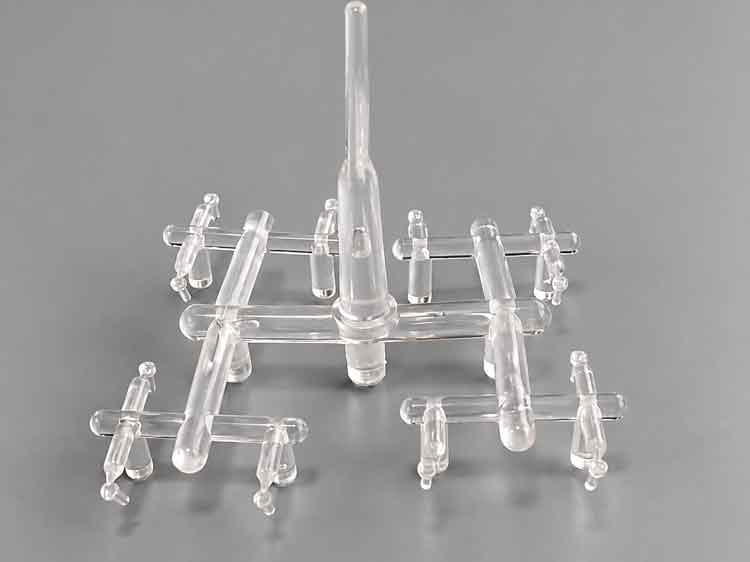
Overview — Custom Plastic Light Pipe
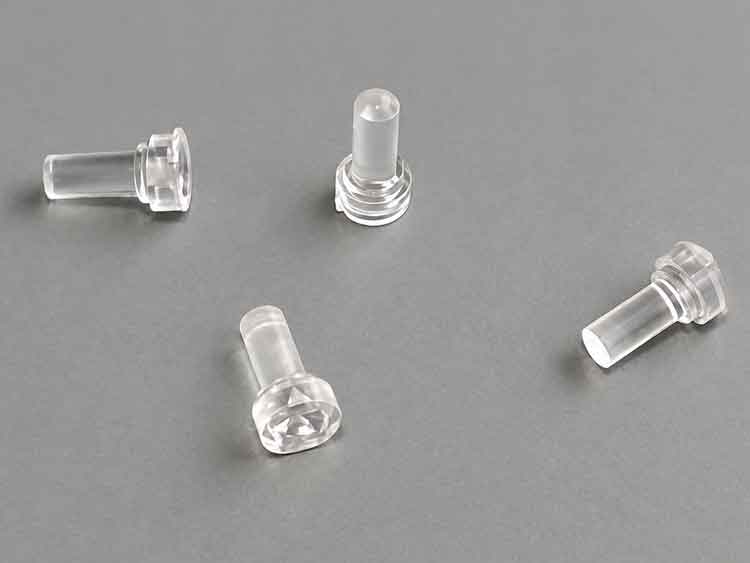
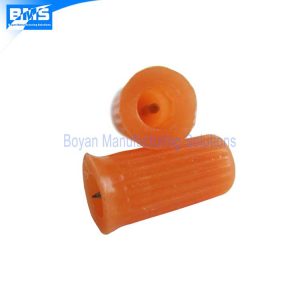
This custom plastic light pipe is a custom-molded component designed to transmit light from PCB-mounted LEDs to the outside surface of a plastic enclosure.
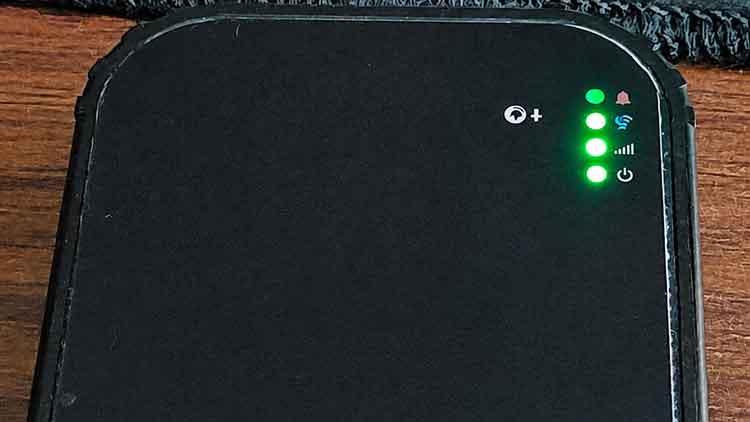
Each enclosure uses four individual LED light pipes. The four parts are separated rather than molded as one transparent piece, helping reduce optical crosstalk so that light from one LED does not illuminate the neighboring indicators.
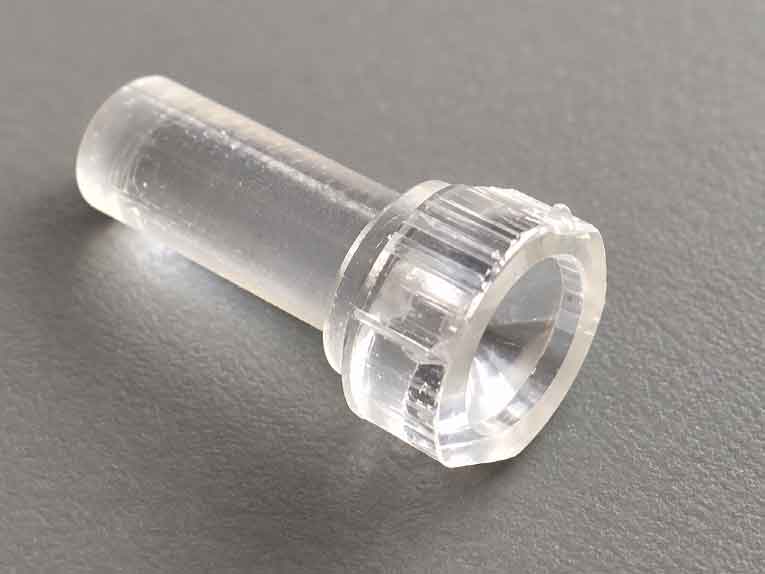
Although the part is extremely small, it is not a simple cylindrical pin. The geometry includes several fine molded details, including stepped diameters and a recessed feature on the end face only 0.2 mm deep. These features make the part suitable for micro injection molding and require tight control of both mold accuracy and the molding process.
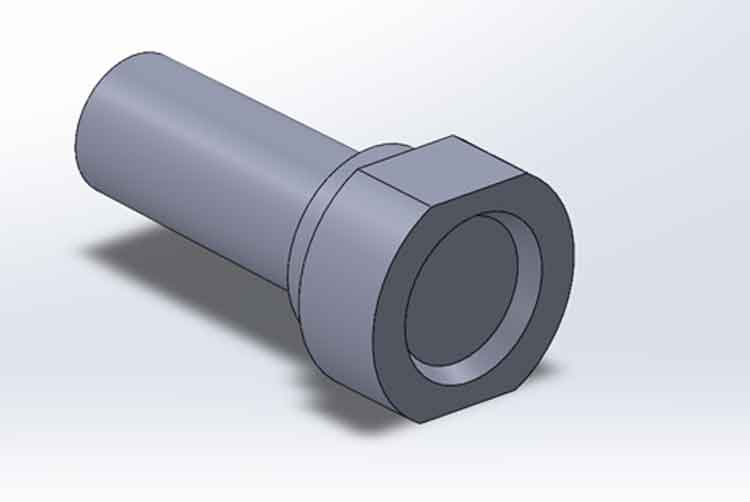
After molding, the light pipes are assembled into the enclosure by ultrasonic welding. For this application, ultrasonic welding provides a cleaner and more repeatable assembly than adhesive bonding, without glue residue or curing time.
Product information
| Item | Details |
|---|---|
| Product dimension | Ø2.5 mm (head)/Ø 1.4 mm * Length 4.6 mm |
| Part weight | Approx. 0.01 gram |
| Material | Clear polycarbonate (PC) |
| Mold information | 12 cavities, cold runner |
| Gate type | Edge gate |
| Tolerance for key dimensions | ±0.05mm |
Key features
Critical Molding Requirements for a Small Clear Plastic Part
A small clear plastic part can be more difficult to mold than its size suggests.
Because the finished component is transparent and used to transmit LED light, visible defects such as bubbles, silver streaks, flow marks, burn marks, contamination, or incomplete filling can affect both appearance and light transmission.
For this project, the sprue, runner, and gate were therefore sized relatively generously compared with the extremely small part volume. The larger flow sections help reduce excessive flow resistance, shear, and premature freezing of the polycarbonate melt before the cavity is fully filled and packed.
Edge Gate Design for the LED Light Pipe
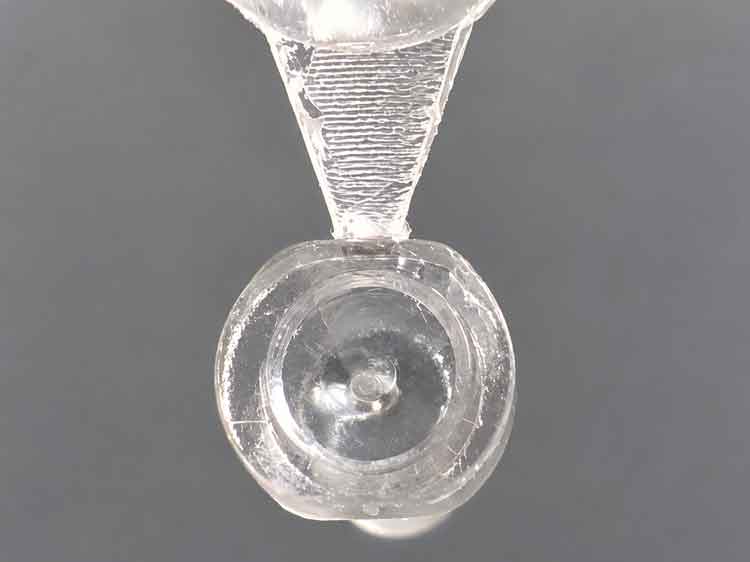
An edge gate is used to fill each plastic light pipe.
The gate must provide enough flow area for stable filling of clear PC while remaining small enough to limit the visible gate vestige after trimming. This balance is especially important because the molded part weighs only about 0.01 g.
After molding, the gate is manually trimmed. A small gate scar or gate vestige remains at the trimming location, so careful trimming is required to keep this mark as small and consistent as possible.
For a custom molded transparent component, gate design is therefore not only a filling consideration; it also directly affects the appearance of the finished part.
A 0.01 g Part with More Than 10 g of Runner Material
One unusual aspect of this project is the large difference between the weight of the finished part and the weight of the cold-runner system.
Each plastic light pipe weighs only about 0.01 g, while the sprue and runners together weigh more than 10 g.
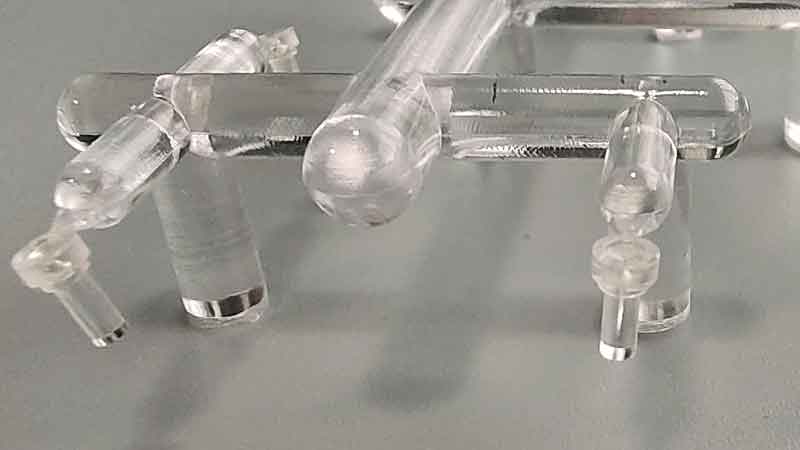
For a custom molded micro part, this means the raw-material consumption is determined mainly by the runner system rather than by the finished component itself.
A hot-runner injection mold could reduce runner waste, but the production volume for this project does not justify the additional mold cost and complexity. Instead, we use a 12-cavity cold-runner mold.
Increasing the cavity number allows 12 light pipes to be molded in each cycle, helping distribute the runner material and molding cost across more finished parts and reducing the unit cost.
High-Precision Injection Mold for Micro Injection Molded Parts
The small size of this LED light pipe places particularly high requirements on the injection mold.
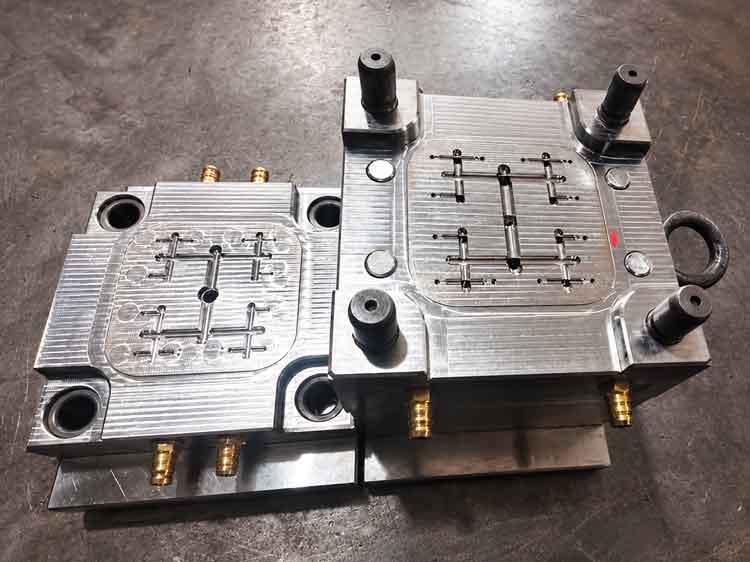
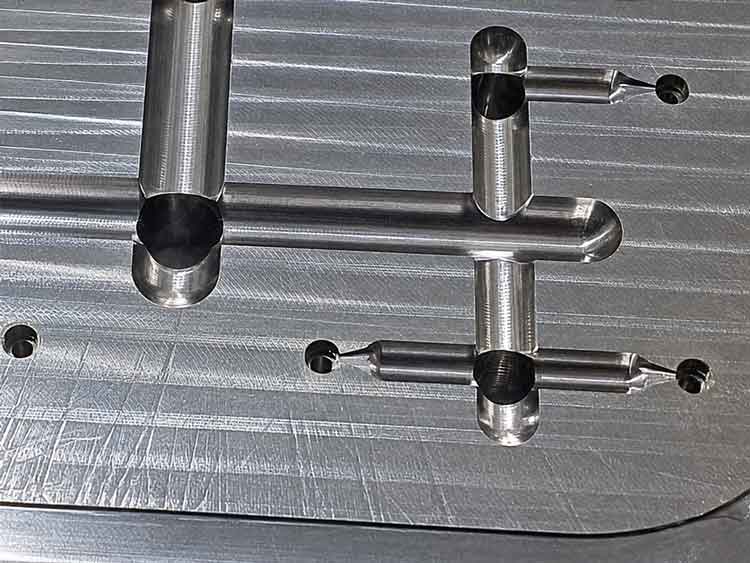
The complete part is only 4.6 mm long and weighs approximately 0.01 g, while some molded details are only a fraction of a millimeter in size. The recessed step on the end face, for example, is only 0.2 mm deep.
These features make the component suitable for micro injection molding, where mold accuracy becomes critical. High-precision machining equipment is required to produce the cavity, small stepped features, gate geometry and parting surfaces accurately.
The mold must also maintain good cavity-to-cavity consistency across all 12 cavities. Small dimensional deviations that would be insignificant on a larger molded product can become important on a micro-sized plastic light pipe, particularly where the part must fit into an enclosure and align correctly with the PCB-mounted LED.
Custom Plastic Light Pipe Injection Molding
This project combines several molding challenges in one component: very small part size, clear polycarbonate material, fine molded details, visual quality requirements and controlled light transmission.
For custom plastic light pipe projects, the final part quality depends not only on the optical material but also on the complete manufacturing system—from injection mold accuracy and gate design to material drying, runner sizing and PC injection molding parameters.
The result is a compact, individually molded LED light pipe that transfers light from the internal LED to the enclosure surface while keeping adjacent indicator lights visually separated.