


Table of Contents
ToggleThe Challenge in Stainless Steel Tube Welding: Discoloration and Warping
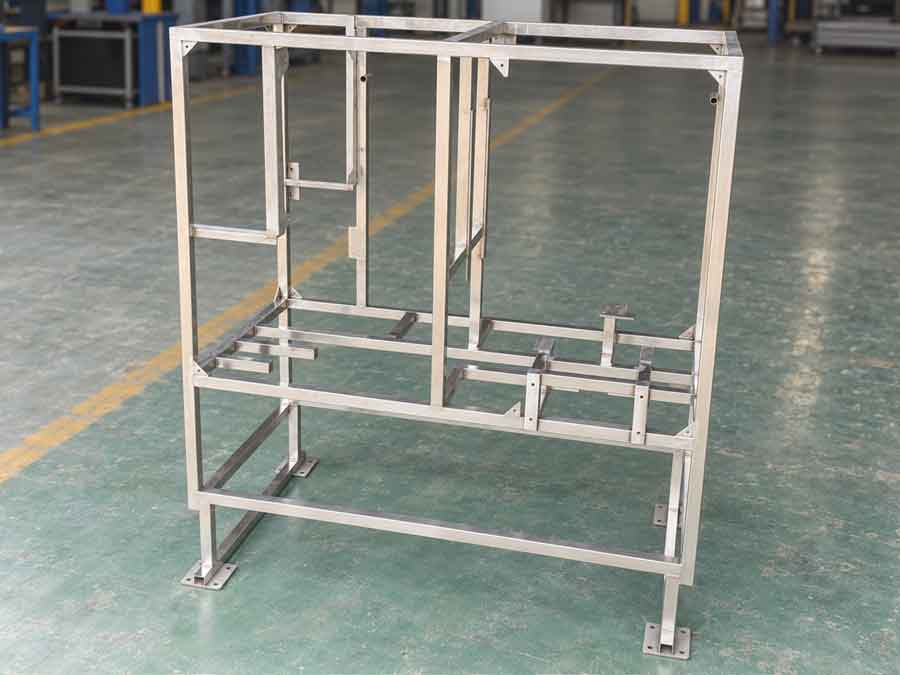
In stainless steel tube welding, joint strength is only one part of the challenge. For visible tube frames, stainless steel weld discoloration and heat-induced tube warping can be just as important, because they affect the appearance, dimensional accuracy, and amount of post-weld finishing required.
For buyers comparing stainless steel tube welding companies, these practical results may matter more than the welding method alone. In one of our recent frame projects, we used filler-wire laser welding stainless steel tubes to reduce the heat introduced around the joints. After welding, some black residue was visible, but it could be wiped away easily, leaving the surface close to the original stainless steel color. The frame also showed relatively little tube warping.
Why Weld Discoloration Matters on Stainless Steel Frames
Why Stainless Steel Tubes Are Used
Stainless steel tubes are often selected for two main reasons: their clean appearance and their corrosion resistance. For a frame with exposed metal surfaces, heavy weld discoloration can therefore affect both of these advantages.
What Causes Stainless Steel Weld Discoloration?
The discoloration seen around a stainless steel weld is mainly caused by high-temperature oxidation. During welding, chromium and iron at the surface react with oxygen and form a thicker oxide layer containing chromium oxides, iron oxides, and mixed oxides. As this oxide layer becomes thicker, it produces the familiar yellow, brown, blue, purple, or black heat tint.

How Weld Discoloration Creates a Chromium-Depleted Zone
More importantly, forming these oxides consumes chromium from the metal immediately beneath the surface. This can create a chromium-depleted zone below the heat-tinted area. Chromium is the key element that allows stainless steel to form its extremely thin, protective chromium-rich passive film.
Why Chromium Content Matters for Corrosion Resistance
About 10.5% chromium is commonly regarded as the minimum level required for steel to behave as stainless steel under normal conditions. If the chromium concentration in a local surface region becomes too low, its ability to form and maintain a protective passive film is reduced. If that film is scratched or damaged, the chromium-depleted area also has less ability to re-passivate, or “self-heal,” making localized corrosion more likely.
For this reason, reducing stainless steel weld discoloration is not only an appearance issue. It can also help preserve the corrosion-resistant surface condition that made stainless steel attractive for the frame in the first place.
Why Stainless Steel Tubes Are More Prone to Welding Bowing
Another common problem in stainless steel tube welding is weld-induced bowing or deformation. This is especially noticeable on long, thin-walled tubes used in frames. When one side of a tube is heated and then contracts during cooling, the tube can bend away from its original straight shape.

Why Austenitic Stainless Steel Is Commonly Used for Welded Tubes
Austenitic Stainless Steels — 304, 304L, 316, 316L
Austenitic stainless steels are our most common choice for welded tube structures. They have good weldability and normally do not require preheating or post-weld heat treatment.
Because of these advantages, they are widely used in welded piping, tanks, pressure vessels, food-processing equipment, and stainless steel tube frames.
Their main disadvantage during welding is their relatively high thermal expansion and low thermal conductivity, which make them more prone to weld-induced deformation.
Ferritic Stainless Steels — 409, 430, 444
Ferritic stainless steels have lower thermal expansion than austenitic grades, which can help reduce welding deformation.
However, they are more sensitive to excessive heat input. High welding temperatures can cause grain growth in the heat-affected zone and reduce toughness. Heat input therefore needs to be carefully controlled.
Preheating may be used for some grades, thick sections, or highly restrained joints, but it is not required for all ferritic stainless steels.
Martensitic Stainless Steels — 410, 420, 440C
Martensitic stainless steels generally have a higher carbon content and a stronger hardening tendency.
Depending on the grade and thickness, preheating—often around 200–300°C—and post-weld heat treatment may be required to reduce hardness and prevent cracking.
For stainless steel tube welding, austenitic grades therefore offer the best combination of weldability and fabrication convenience, but their thermal properties also make distortion control especially important.
Why Austenitic Stainless Steel Warps More Than Carbon Steel
A comparison between 304 stainless steel and a typical low-carbon steel such as AISI 1020 shows why:
| Thermal Property | 304 Stainless Steel | AISI 1020 Carbon Steel | What It Means for Welding |
|---|---|---|---|
| Specific Heat | ~500 J/kg·K | ~486 J/kg·K | Very similar This is not the main reason stainless steel warps more. |
| Thermal Conductivity | ~16.3 W/m·K | ~51.9 W/m·K | Carbon steel conducts heat about 3× faster. Heat stays more concentrated around the weld in 304 stainless steel. |
| Linear Thermal Expansion | ~17.3 × 10⁻⁶/K | ~11.7 × 10⁻⁶/K | 304 expands about 48% more. Greater expansion and contraction increases the tendency to bow or warp. |
The key difference is therefore not specific heat. Austenitic stainless steel has much lower thermal conductivity and a significantly higher thermal expansion rate than carbon steel. During welding, heat remains concentrated near the joint while the stainless steel expands and contracts more, making tube bowing and weld-induced deformation more likely.
Please note: The 304 values are published by Nippon Steel, while the AISI 1020 values are typical reference values reported by MatWeb. Actual values vary somewhat with temperature and material condition.
The biggest difference is thermal conductivity. Carbon steel conducts heat away from the weld roughly three times faster than 304 stainless steel.
At the same time, the thermal expansion of 304 is almost 50% higher, while the specific heat of the two materials is quite similar.
This creates an unfavorable combination during welding:
heat stays concentrated near the weld, while the heated stainless steel expands and contracts more.
As the weld cools, this uneven contraction can pull a straight tube into a bowed shape. World Stainless similarly notes that the relatively low thermal conductivity and higher thermal expansion of austenitic stainless steels increase their tendency to distort during welding.
Why Excessive Weld Warping Is a Problem
Excessive tube bowing affects more than appearance.
It can change the overall dimensions and alignment of a frame, create problems during later assembly, and require additional straightening after welding.
Large deformation can also indicate that the welding parameters, welding sequence, or heat input are not well controlled. Although fixtures can restrain visible movement during welding, excessive restraint may leave higher residual stresses in the finished assembly.
In austenitic stainless steel, these residual tensile stresses can also increase susceptibility to stress-corrosion cracking when the part is exposed to an appropriate corrosive environment, particularly one containing chlorides.
For this reason, reducing unnecessary heat input is important not only for appearance and dimensional accuracy, but also for controlling the stresses introduced during welding.
This is one of the main reasons we considered laser welding stainless steel tubes for this frame: reducing the total heat introduced around each joint can help reduce both weld-related surface effects and tube warping.
What We Saw in This Stainless Steel Tube Welding Case
For this project, we used 30 × 30 × 2 mm stainless steel square tubes to fabricate the frame. Instead of conventional TIG welding, we used filler-wire laser welding.
Our main concerns were the same problems we often see in stainless steel tube welding: weld discoloration, tube bowing, and the amount of post-weld correction required.
The video shows the actual welding process as well as the condition of the frame after welding.
The Weld Area Stayed Close to the Original Stainless Steel Color
Immediately after welding, some black material could be seen around parts of the weld.
At first glance, this may look like heavy stainless steel weld discoloration. However, much of the black material could be wiped away easily. After cleaning, the surface underneath remained close to the original natural color of the stainless steel.

This was important to us because removing weld discoloration after conventional welding is not always as simple as it appears.
Electrolytic Weld Cleaning Has Its Limitations
Electrolytic weld cleaning and passivation can produce a very clean appearance immediately after treatment. However, the chemicals used in the process must be thoroughly neutralized and rinsed away.
If residues remain on the surface or in small gaps, staining or patchy corrosion marks may appear later.
Blasting Changes the Original Surface Finish
Blasting is another option. It can remove the discoloration and produce a uniform surface, but it also changes the original stainless steel finish into a more matte appearance.
For some products this is acceptable or even desirable, but for others it is not the preferred finish.
For this reason, we prefer to reduce weld discoloration during the welding process whenever possible rather than depend heavily on post-weld surface treatment.
Tube Bowing Was Relatively Small

We also checked how much the square tubes had bowed after welding.
For a practical shop-floor check, we placed a straight spirit level against the welded 30 × 30 × 2 mm square tube and observed the gap between the straight edge and the tube surface.
The bowing we observed was approximately 0.5–2 mm, depending on the location.
This was not intended as a precision dimensional inspection, but it gave us a useful indication of the amount of weld-induced deformation in the frame.
F-Clamps Were Enough for Straightening
More importantly, the remaining bowing could usually be corrected using F-clamps to pull the tubes back into alignment.
With our previous TIG welding process, the heat-induced deformation was often greater. In some cases, simple mechanical correction was not enough and flame straightening was required.

From a production standpoint, this difference matters.
Correcting a slightly bowed tube with clamps is much simpler than applying additional localized heating to straighten a welded frame. Flame straightening adds another thermal process, requires operator experience, takes additional time, and can further affect the appearance of the stainless steel surface.
So in this case, the benefit of laser welding was not that the frame had absolutely zero deformation. Rather, the deformation was small enough that the remaining correction was relatively simple.
Filler Wire Helps, but Good Fit-Up Still Matters
We used filler-wire laser welding rather than autogenous laser welding.
The filler wire gives us some ability to bridge small joint gaps, which is useful when welding a fabricated tube frame. However, we still prefer the gap between the tubes to be small and consistent.
As the gap becomes larger or more irregular, welding becomes noticeably more difficult.
Larger Gaps Make the Process More Sensitive
The process becomes more sensitive to factors such as:
- filler-wire position,
- wire-feed rate,
- welding speed,
- laser position,
- joint geometry,
- and the consistency of the gap.
As a practical shop-floor rule, when the filler-wire diameter is larger than the joint gap, bridging the gap is generally more feasible. However, this does not mean that every large gap can or should be welded successfully.
An experienced operator may sometimes compensate for a larger gap by adjusting the wire position or welding technique, but we normally do not want to rely on this in production.
Our preferred solution is to produce an accurate joint before welding.
Good Welding Starts with Good Tube Cutting
This is especially important for stainless steel tube frames.
When one square tube meets another, the accuracy of the cut directly determines the joint gap.
If the notch or tube intersection is inaccurate, the welder must compensate for a problem that should ideally have been solved during cutting and fitting.
Accurate Cutting Improves Welding Consistency
Accurate tube cutting therefore provides several practical advantages:
- more consistent joint gaps,
- more stable filler-wire feeding,
- more uniform weld appearance,
- and less variation from one frame to another.
For this reason, we treat tube cutting, fit-up, fixturing, and welding as parts of the same manufacturing process rather than separate operations.
Is the Laser-Welded Joint Strong Enough?
A cleaner weld and less tube bowing are useful only if the joint is also strong enough for the application.
Because a laser weld can appear narrower than a conventional TIG or MIG weld, it is reasonable to ask whether the joint has sufficient strength.
Our Hammer-Impact Demonstration
For this frame, we performed a simple shop-floor hammer-impact demonstration, which is also shown in the video.
We repeatedly struck the welded joint with a hammer, and the joint remained intact under the impacts.
This gave us practical confidence in the robustness of the weld for this application.
This Was Not a Standardized Mechanical Test
However, this should not be confused with a standardized mechanical test. It was not a tensile, bend, fatigue, or certified destructive test.
For products with defined structural or safety requirements, appropriate engineering calculations and standardized testing should still be used.
Why Laser Welding Produces a Different Result
The main advantage of laser welding stainless steel is not simply that the laser is “hotter.” What matters more is how concentrated the heat is and how short the heating time is.
High Energy Concentration in a Very Small Area
A laser focuses a large amount of energy onto a very small spot. The stainless steel in the weld pool must still be heated above its melting temperature—roughly around 1,400°C or higher, depending on the grade.
The laser beam itself should not be described as having a fixed “temperature.” Instead, it delivers very high power density to a small area, allowing the metal to melt rapidly without heating a large surrounding region.
This is why laser welding can produce a relatively narrow weld and a small heat-affected zone. TWI describes low heat input, narrow HAZ, and low distortion as characteristic advantages of laser welding.
The Heating Time Is Very Short
Laser welding is also a fast process.
Depending on the material thickness, laser power, joint design, and welding mode, welding speeds can range from tens of millimeters per second to several meters per minute. A given point on the tube may therefore be exposed to the concentrated heat source for only milliseconds or a small fraction of a second.
This short thermal cycle is particularly important for stainless steel. It also helps improve productivity because welding can be completed faster, with less time spent on post-weld straightening, cleaning, grinding, or surface finishing.
Why Laser Welding Reduces Discoloration and Tube Bowing
Both problems have the same basic cause: excessive heat input and a long thermal cycle.
Laser welding concentrates the energy in a very small area and completes the weld quickly. This means less surrounding metal is heated, and it remains at high temperature for a shorter time.
As a result:
- less oxide forms on the stainless steel surface, so weld discoloration is reduced;
- less material expands and contracts, so tube bowing and deformation are reduced.
This is the main reason laser welding can produce a cleaner appearance and better dimensional stability on stainless steel tube frames.
Limitations of Laser Welding
Laser welding offers clear advantages for stainless steel tube frames, but it also has some practical limitations.
Joint Gaps Need to Be Small and Consistent
Laser welding is more sensitive to joint fit-up than conventional TIG or MIG welding.
For our filler-wire process, we normally use wire with a diameter of about 1 mm. As a practical production guideline, we prefer the joint gap to be around 0.5 mm and generally keep it below 1 mm.
When the gap becomes wider than the filler wire diameter, maintaining a stable and consistent weld becomes much more difficult. An experienced operator may sometimes bridge a larger gap by adjusting the wire position and welding technique, but we do not recommend relying on this in normal production.
For this reason, laser welding works particularly well with square tubes that have accurately cut, flat mating surfaces.
More Complex Tube Intersections Require Accurate Laser Tube Cutting
Laser welding is more sensitive to joint fit-up than conventional TIG or MIG welding.
For our filler-wire process, we normally use wire with a diameter of about 1 mm. As a practical production guideline, we prefer the joint gap to be around 0.5 mm and generally keep it below 1 mm.
When the gap becomes wider than the filler wire diameter, maintaining a stable and consistent weld becomes much more difficult. An experienced operator may sometimes bridge a larger gap by adjusting the wire position and welding technique, but we do not recommend relying on this in normal production.
For this reason, laser welding works particularly well with square tubes that have accurately cut, flat mating surfaces.
More Complex Tube Intersections Require Accurate Laser Tube Cutting
When the tube end is angled, curved, or intersects with a round tube, maintaining a small and uniform joint gap becomes more difficult.
In these cases, we prefer to use a rotary-head laser tube cutting machine to cut the intersection profile accurately. This allows the mating surfaces to follow each other closely and keeps the joint gap small enough for stable laser welding.
Good laser welding therefore starts with accurate tube cutting and fit-up.
Material Thickness Is Limited by Laser Power and Penetration
Laser welding is also not the best choice for every material thickness.
For the type of fiber laser welding equipment we use, the achievable single-pass thickness depends strongly on laser power. If the material is too thick for the available power, the weld may not achieve full penetration, creating a risk of incomplete penetration or lack of fusion.
The equipment guideline shown below gives the following approximate thickness ranges:
| Laser System | Power | Recommended Thickness |
|---|---|---|
| Air-Cooled | 700 W | 0.4–2.5 mm |
| Air-Cooled | 1200 W | 0.4–3.5 mm |
| Air-Cooled | 1500 W | 0.4–4.5 mm |
| Air-Cooled | 2000 W | 0.4–6 mm |
| Water-Cooled | 1000 W | 0.4–3 mm |
| Water-Cooled | 1500 W | 0.4–4 mm |
| Water-Cooled | 2000 W | 0.4–6 mm |
| Water-Cooled | 3000 W | 0.4–8 mm |
These values should be treated as equipment recommendations rather than universal laser-welding limits. Actual penetration also depends on material, joint design, welding speed, focal position, filler wire, and other process parameters.
For thicker structural sections, conventional welding or a different laser-welding setup may therefore be more practical.
Looking for a Stainless Steel Tube Welding Company?
For buyers comparing stainless steel tube welding companies, the best solution is not simply the one that produces a strong weld. Appearance, tube warping, joint fit-up, post-weld finishing, and production efficiency also need to be considered.
At Boyan Manufacturing, we combine stainless steel tube fabrication, accurate tube cutting, filler-wire laser welding stainless steel, fixturing, and dimensional control to produce welded tube frames with cleaner welds and less deformation.
If your project involves stainless steel weld discoloration, tube bowing, or difficult post-weld finishing, send us your drawings and requirements. We can review whether laser welding is a suitable process for your stainless steel tube or frame assembly.